Schedule your 100 hour service
Dockside service across St. Pete, Clearwater, Tampa, Tierra Verde, and Gulfport.
The 100-hour outboard service is the first real maintenance milestone every Tampa Bay boater hits, and it's the place shortcuts start showing up on the bill years later.
Your engine just rolled past the 100-hour mark, or maybe you're holding a quote and trying to figure out what's actually on it. Either way, the gap between a quick oil-and-filter swap and a proper 100-hour service is bigger than most shops admit. That gap is where you end up paying for a powerhead rebuild at 500 hours.
At Mobile Marina, our USCG-certified captains coordinate scheduled service routes across St. Pete, Clearwater, Tampa, Tierra Verde, and Gulfport. We service most boats right at the slip. For boats stored on a trailer at home, we coordinate pickup and drop-off so the engine never becomes a logistics problem you have to solve.
For the next milestone, see the 300-hour service breakdown. The two articles work together as a maintenance roadmap. For the dockside service we run on outboards across Tampa Bay, see our outboard maintenance service page.
Why the 100-Hour Is the Most Important Early Service You'll Pay For
Your outboard went through a lot in its first 100 hours. During break-in, internal components like piston rings seat against cylinder walls for the first time, and that process sheds microscopic metal particles into the factory oil. The 20-hour break-in service gets you through the initial settling period, but the 100-hour service is where you move from "new engine" to "engine with a documented history." That distinction matters when warranty claims, resale, and service planning all depend on documented intervals.
Even after the 20-hour service, the oil keeps picking up wear metals as components finish seating. By 100 hours, that oil is carrying particles you do not want grinding through bearings or the lower unit. This is especially true on larger outboards (200hp+) where the break-in loads are higher and the tolerances are tighter. Draining it on schedule is one of the cheapest things you'll ever do to protect a multi-thousand-dollar powerhead. We've pulled 100-hour oil that looked like it had glitter in it. That "glitter" is your piston rings and cylinder walls finding their final fit, and you want every last particle out before it circulates through another 200 hours of operation.
Your first anode replacement at 100 hours also establishes how fast your boat consumes sacrificial zinc in its actual environment, and a documented 100-hour service is the first real entry in your engine's maintenance record. A boat sitting in a Gulfport marina with older neighboring wiring can chew through anodes faster than one docked in Clearwater. Stray current from shore power and mixed metals on neighboring boats drive the difference. Without that first data point, you're guessing on intervals. And when you sell the boat 5 or 10 years later, buyers and surveyors look at whether this service was done on time. A gap here raises questions about everything that followed.
The water pump, the fuel filter, the spark plugs, the gear lube, the linkage grease. None of these are dramatic on day one. They quietly degrade together. When we see major problems at 300 or 500 hours, a skipped or rushed 100-hour interval is, more often than not in our Tampa Bay service work, one of the common patterns in the records. The 100-hour isn't technically harder than later intervals. Its importance is that it establishes the service baseline and catches break-in issues before they compound into something the 300-hour technician has to untangle.
What's on the 100-Hour Service Invoice (the Mobile Marina Version)
This is the actual checklist our technicians work through. It's the same scope on every 100-hour service we run, regardless of which slip your boat sits in or which brand is on the cowling. This covers 4-stroke outboards. 2-stroke service intervals differ; contact us for your specific engine.
Engine diagnostic scan. We connect to the engine's onboard diagnostic system and pull stored fault codes, runtime data, and any flagged anomalies. Yamaha engines use YDS, Mercury uses CDS, and Suzuki uses SDS. The scan runs before any wrenches come out so we know what the engine is reporting.
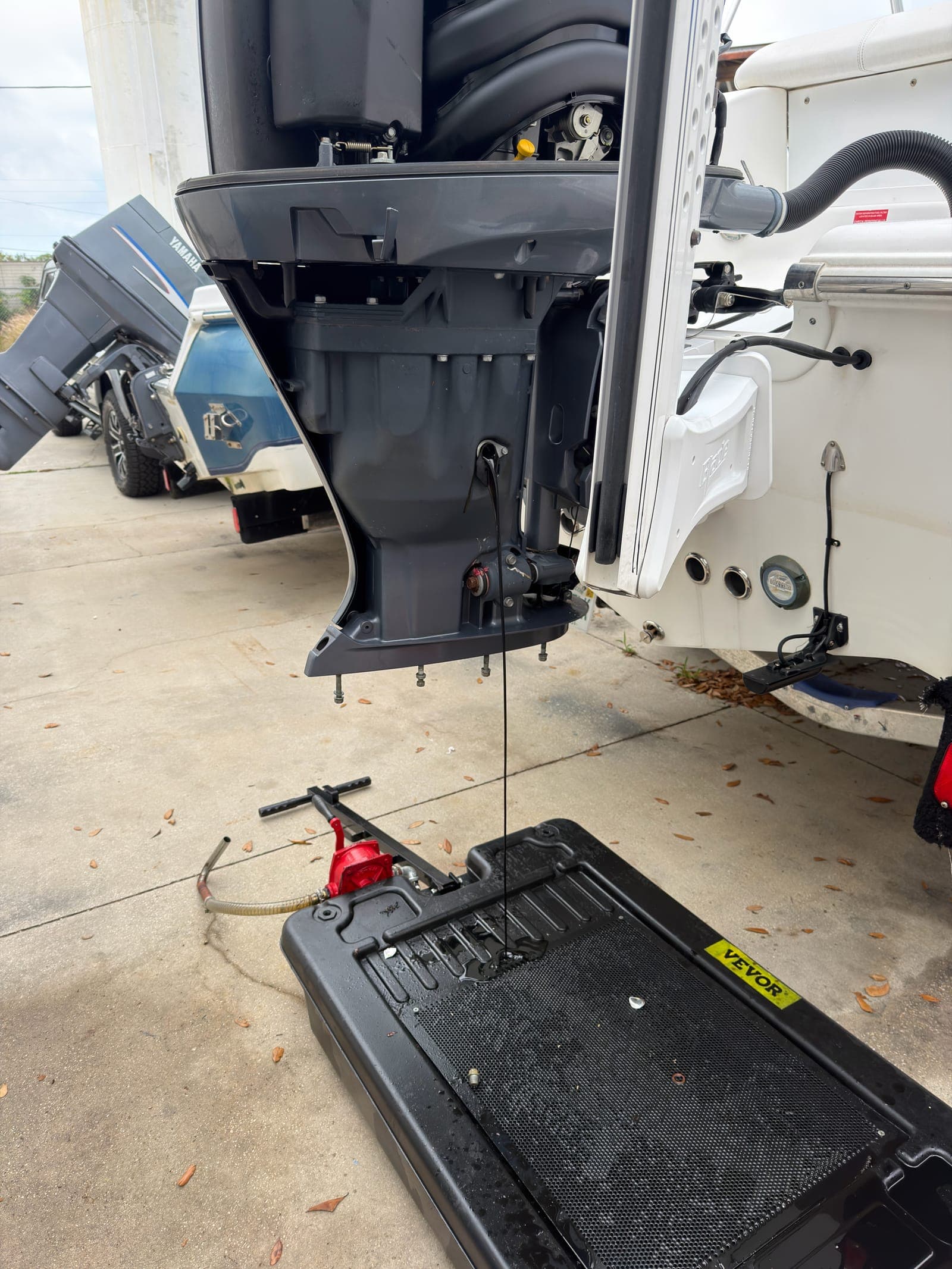
Change gearcase oil and drain gasket. This is the one we actually look forward to on a 100-hour engine. First lower-unit gear lube change is critical because break-in debris and any moisture intrusion shows up here. We pull the magnetic drain plug and study what comes out. Fine metallic dusting is normal on a first drain. Anything beyond that (chunks, milky color, water droplets on the magnet) tells a story about how the lower unit has been living. The drain gasket gets replaced every time. A lot of shops skip that part and end up chasing lower-unit leaks later. We've had boats come in for 300-hour service where we can tell nobody ever looked at the first drain, and by then you're guessing whether the moisture problem started at hour 30 or hour 250.
Change engine oil and filter. Drained completely, refilled with the correct marine-spec oil, filter replaced. We restart and check oil level and quality after a few minutes to confirm the filter sealed and nothing's leaking.
Fuel system filters. Both the water separator and the primary engine-mounted filter get replaced, not inspected. The separator catches contamination before it reaches the engine. A partially saturated filter doesn't advertise that on the outside. Same goes for the primary filter media. We've pulled filters that looked clean externally and were half-blocked inside.
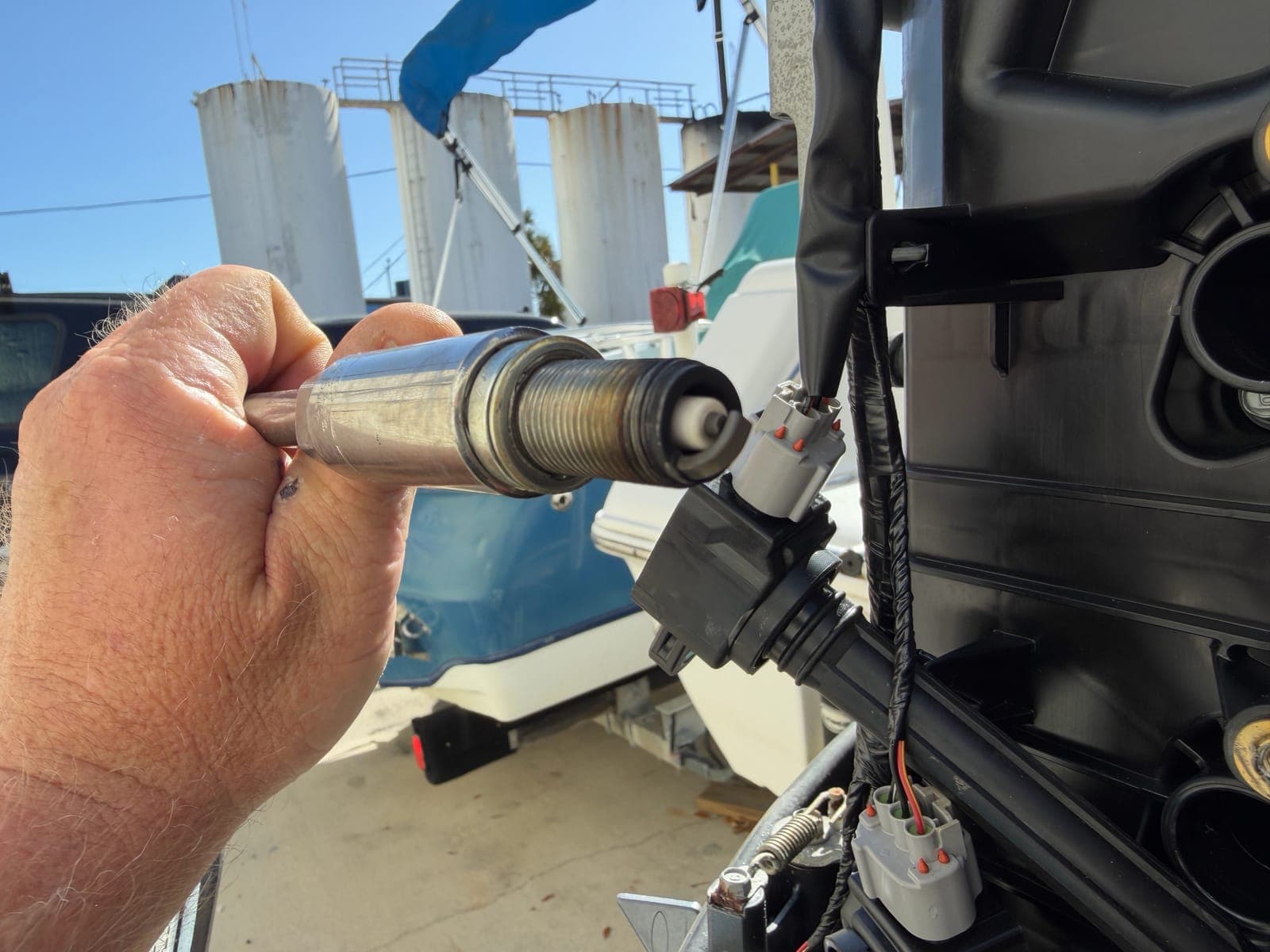
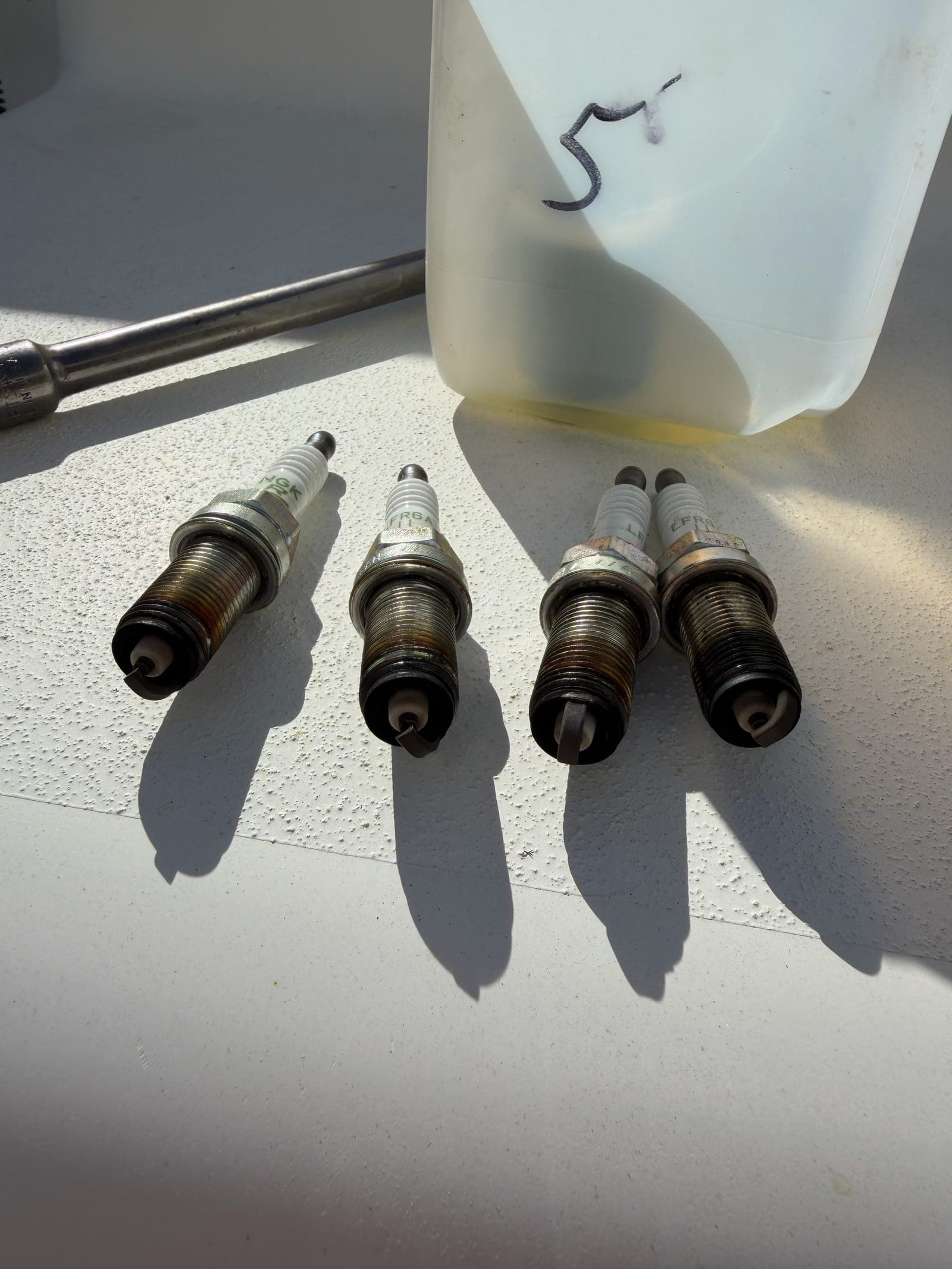
Replace spark plugs. On most 4-strokes, plugs are often still serviceable at 100 hours. On freshwater engines, plugs at 100 hours are usually fine. In Tampa Bay's salt environment, we see enough accelerated electrode wear and deposit buildup that replacing them at this interval is cheap insurance. We're already in there, and the cost of new plugs is trivial next to the diagnostic headache of chasing a misfire later.
Replace zinc and bracket anodes. Saltwater in Tampa Bay is relentless. We replace anodes at every 100-hour service rather than measuring percentages of consumption. Once an anode shows visible depletion, you're operating with reduced protection. The manufacturer (OEM) threshold is typically 33% consumed, and saltwater boats in our area, particularly zinc anodes on boats with shore power connections, often hit 40–60% by 100 hours. We'd rather replace proactively than bet on the remaining margin.
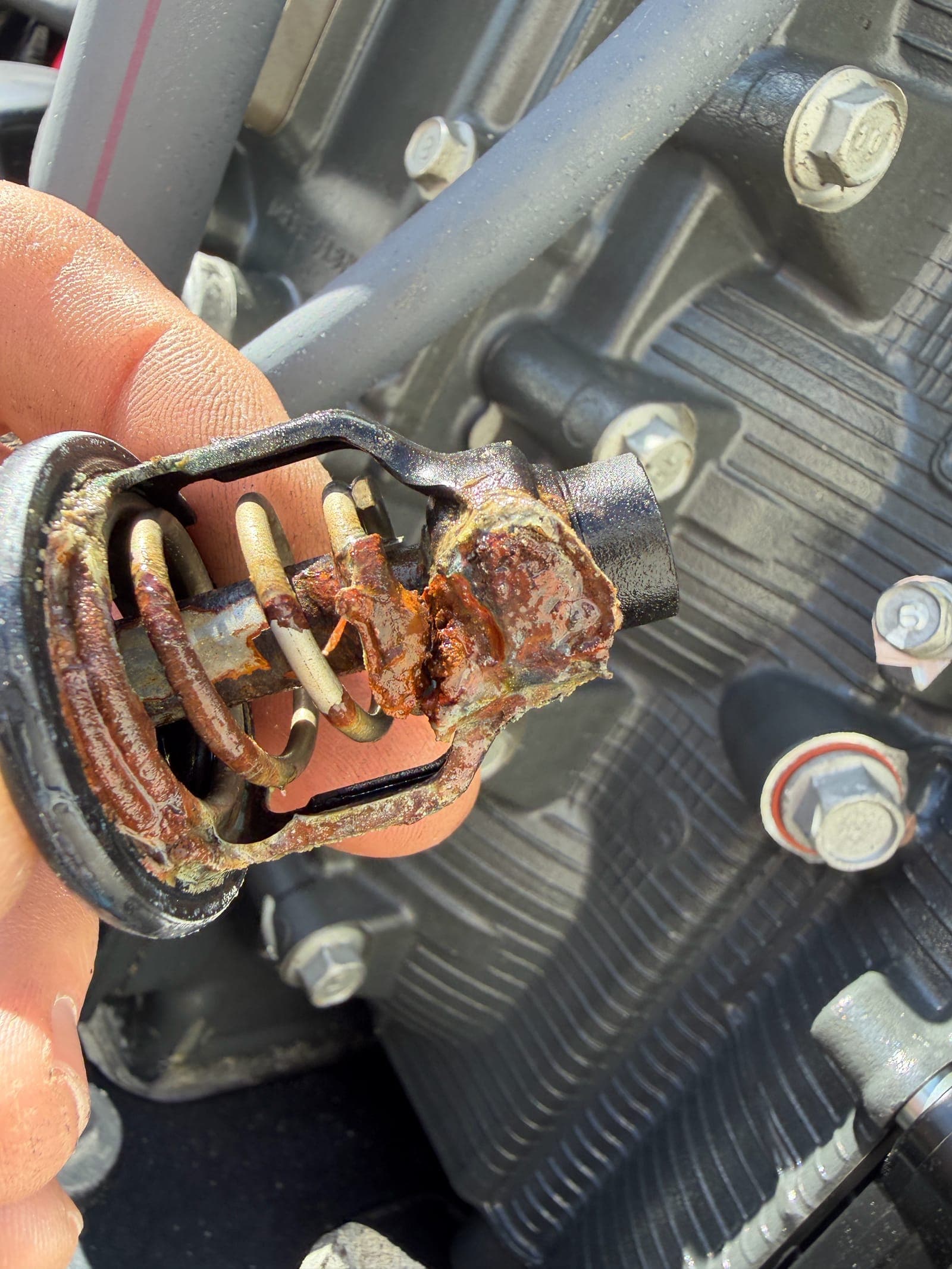
Replace water pump assembly. Most OEM schedules call for impeller inspection at 100 hours and full replacement at 300. We replace the full assembly (housing, impeller, and wear plate together) at 100 because in Tampa Bay's saltwater, we've seen too many "passed inspection" impellers fail before 200 hours. It's a more aggressive interval and it adds to the cost, but it resets the cooling system completely instead of carrying forward a housing with scoring or a wear plate that's borderline.
Engine wipe down and salt removal. Salt residue on every surface inside the cowling. Controls corrosion before it starts.
Apply CRC corrosion blocker. A protective coating goes on every electrical connection, terminal, and exposed metal surface. This is one of the cheapest things we do and one of the highest-impact for engines living in salt air year-round.
Grease all fittings. Throttle linkage, shift linkage, steering, trim. Marine-spec grease at every fitting.
Written service report. The whole service is documented. You get a full report of what was done, what we observed, and anything we'd flag for attention before the 300-hour interval.
Real 100-Hour Service Cost Ranges
A 100-hour outboard service costs different amounts depending on where and how you get it done. The gap between options is bigger than most boaters expect.
Scope matters: read the footnote before comparing the numbers below.
| Who Does the Work | Single 150–200hp (Under 25ft) | Single 225–300hp / Mid-Size Cruiser | Twin Engine or Larger Vessel |
|---|---|---|---|
| Mobile Marina | $1,000 | $1,100–$1,200 | $1,300–$1,400 |
| Dealer Shop* | $300–$600 | $400–$800 | Varies widely |
| DIY Parts-Only Kit | $150–$220 | $180–$280 | Roughly double the single-engine kit |
*Dealer pricing varies widely. The ranges above are approximate based on quotes Tampa Bay boaters have shared with us. Your local dealer may differ. The key is comparing what's actually included line by line. The low end of those ranges typically covers oil, filter, and gear lube only. Most base dealer quotes do not include the water pump replacement, full anode swap, or CRC corrosion treatment that we run as standard.
Our pricing is flat-rate across brands. Yamaha, Mercury, Suzuki, Honda. The same service at the same price whether your boat is tied up in Clearwater or in Gulfport.
We do cost more than a dealer shop. What that number covers: a qualified marine technician comes to your slip, runs the full service in 4–6 hours on-site, replaces the parts that need replacing instead of inspecting them and writing them up for next time, and hands you a written service report you can keep for warranty documentation or resale. No trailering across town. No 2–4 week wait for a yard slot. No storage fees stacking up while your boat sits behind a dealer.
The DIY route is the cheapest option if you have the tools, the know-how, and a place to work. Most people would rather be on the water than elbow-deep in gear lube on a Saturday. And if a DIY job misses something like a corroded anode or a water pump impeller starting to fail, you won't know until it shows up on the water.
Expert Marine Maintenance
From routine service to major repairs, our team of expert marine technicians handles it all. Full project management so you can enjoy your boat.
Expert Technicians
Certified marine specialists
Why Tampa Bay Hits the 100-Hour Milestone Faster Than You Think
Most outboard manufacturers set the first major service interval at 100 hours or one year, whichever comes first. Up north, where boats get winterized and sit for five months, the calendar usually wins. Down here, the hour meter almost always trips first.
In our experience, weekend-only boaters in Tampa Bay typically log 50–80 hours per year, which still hits the 100-hour mark before the second anniversary. Frequent boaters (fishing multiple days a week, charter use) can hit it in 6–9 months. If you bought a new outboard in the spring, you could be due for the service by late fall, well before the one-year anniversary.
Year-round use isn't the only factor. Saltwater eats anodes fast. Even if your zincs look intact at 100 hours, they've been working overtime in our warm saltwater. Florida heat and humidity age fuel filters, rubber lines, and electrical insulation faster than you'd expect from OEM intervals alone. OEM intervals are designed to cover the widest range of operating conditions. In year-round saltwater environments like Tampa Bay, the aggressive end of those intervals is almost always the right call. And if your boat sits on a trailer between trips, the water pump can dry out and develop a set. We replace the full pump assembly at 100 hours rather than inspect and leave it.
Simple rule for boaters in Tampa, Tierra Verde, and Gulfport: service by whichever clock hits first. For most actively-used boats in the bay, that's hours.
DIY vs. Pro: What You Can Actually Do Yourself
Not everything on the 100-hour menu requires a certified technician. If you're handy with a wrench and comfortable working on your engine, a chunk of the checklist is reasonable to handle yourself. There's also a line where DIY stops saving money and starts costing more. Tampa Bay's salt exposure makes that line sharper than it would be on a freshwater lake.
| Task | DIY Friendly? | Risk Level | Notes |
|---|---|---|---|
| Engine oil + filter change | Yes | Low | Straightforward on most outboards |
| Gear lube drain/refill | Yes | Low | Use the correct brand-spec oil; don't substitute |
| Fuel filter replacement | Yes | Low | Both engine-mounted and water separator |
| Anode replacement | Yes | Low | Check all locations; saltwater consumes these fast |
| Battery terminal cleaning | Yes | Low | Clean and re-grease |
| Visual inspections (belts, hoses, fuel lines) | Yes | Low | Look for cracking, swelling, soft spots |
| Spark plug replacement | Maybe | Medium | Low on freshwater engines; medium on salt-exposed outboards where seized plugs are a real risk |
| Water pump replacement | Maybe | Medium | The full pump, not just the impeller; missed fragments can damage the heat exchanger |
| Diagnostic scan | No | High | Requires Yamaha YDS, Mercury CDS, or Suzuki SDS |
| Throttle/idle adjustments (newer EFI) | No | High | Software-controlled on most modern engines |
| Charging system diagnosis | No | High | Beyond visual inspection, leave this to a tech |
The math: parts alone for the DIY-friendly items run roughly $150–$280 depending on brand, plus 3–5 hours of careful work. Professional dockside service runs $1,000–$1,400 all-in, and that buys you the diagnostic scan, the water pump replacement, the corrosion blocker, the grease pass, and the written report you'd otherwise need to track yourself.
Spark plugs and water pumps are where DIY stops being cheaper. Water pump replacements go sideways when fragments of the old impeller break off and lodge in the heat exchanger. Spark plugs on a salt-exposed outboard that's been running hard through Tampa Bay summers can seize in the head. Cross-threading or snapping one off turns a $10 plug into a machine-shop repair. Based on quotes Tampa Bay boaters have shared with us, a helicoil repair on a stripped plug hole runs $150–$300 at a machine shop, but if the head needs to come off the engine, the total including labor can push past $1,000.
If your outboard is still under warranty, documented service from a qualified shop matters. Check your warranty terms before deciding which way to go. Some manufacturers require dealer service specifically, others accept any qualified marine shop, and some allow owner maintenance if properly documented. The specifics matter. A boater with a new Mercury might have different requirements than someone running a Yamaha.
How the Service Actually Happens
For boats kept at a slip (which is most of our work across St. Pete, Clearwater, Tampa, Tierra Verde, and Gulfport) we run scheduled service routes through the area and handle the engine right at the dock. No haul-out, no drop-off at a yard, no waiting 2–4 weeks for a slot. Our team brings the full kit pre-staged: oils, filters, the new water pump assembly, anodes, plugs, marine grease, and the CRC corrosion blocker. A typical visit runs 4–6 hours from arrival to written report.
For boats kept on a trailer at home, we coordinate pickup and drop-off. We bring the boat from your driveway to where the work needs to happen and return it when we're done. That option makes sense for owners who store on land between trips and don't want to spend a day towing across town to a service shop.
We service slips and marinas across St. Pete (downtown waterfront, Bayboro Harbor, surrounding municipal slips), Clearwater (Clearwater Beach Marina area and slips along the Intracoastal), Tampa (Westshore, Davis Islands, Harbour Island), Tierra Verde (slips near Fort De Soto, where afternoon Gulf winds mean we're tying off extra lines half the year), and Gulfport (Boca Ciega Bay marinas and the Gulfport Municipal Marina area).
If you're docked or stored in any of these areas, we come to you. Schedule service through the app or call (727) 607-1050, and we'll get you on the next available scheduled route.
Get Fuel Delivered to Your Slip
Download the Mobile Marina app to schedule dockside fuel delivery, manage your vessel, and access all our services from your phone.

What the 100-Hour Sets Up for Your 300-Hour and Beyond
The 100-hour service creates the only baseline that matters: what does "normal" look like for your engine, in your slip, with your usage pattern? Without it, the 300-hour technician is working blind.
Gear lube condition at 100 hours tells us whether moisture intrusion is happening early. If the drain was clean, a milky drain at 300 hours immediately signals a new problem rather than ongoing neglect. A fresh water pump at 100 resets the cooling system's wear clock, so the 300-hour tech is evaluating 200 hours of impeller wear, not 300. Anode consumption rate from the first swap gives us a number to plan against instead of guessing. And the diagnostic scan baseline means fault codes at 300 hours can be compared against a known-good snapshot.
When the 100-hour gets skipped, the 300-hour service turns into detective work. The technician is seeing the engine for the first time with 300 hours of undocumented wear. Gear lube that's never been changed might show moisture intrusion that started at 50 hours or 250. No way to tell. The water pump might still be running, or it might be on its last season. Every system has to be evaluated as if it's a new patient, which takes longer and costs more. We've seen 300-hour services on skipped-100-hour engines run significantly higher just from the additional diagnosis time and parts that should have been replaced 200 hours earlier.
If you want to see how the full maintenance ladder fits together, from 100 hours through 1,000, the Outboard Motor Maintenance pillar covers the whole picture. The 300-hour service breakdown picks up where this article ends.
Frequently Asked Questions
The Bottom Line
A 100-hour outboard service isn't just a checklist. It's how you catch small problems before they turn into big ones. Skipping it doesn't save money. It just moves the cost somewhere more expensive down the line.
Our team handles 100-hour services for boaters across St. Pete, Clearwater, Tampa, Tierra Verde, and Gulfport. Slip-stored boats get serviced at the dock. Trailer-stored boats get pickup and drop-off. Same service, same flat pricing, same written report.
Ready to get your engine on schedule? Call (727) 607-1050 or visit mobilemarina.co for a free maintenance estimate. We'll keep you on the water.
Related: Outboard Motor Maintenance Pillar | 300-Hour Service Breakdown | Scheduled Engine Service | On-Water Repairs | Service Areas